Welding in Sheet Metal Fabrication: The Backbone of Structural Integrity and Precision Manufacturing
In the global sheet metal fabrication industry, welding is far more than a joining process—it is the structural and functional cornerstone that determines whether a component performs reliably in the field or fails under load. For B2B buyers sourcing fabricated metal parts, understanding welding’s role is essential to evaluating supplier capability, quality consistency, and total cost of ownership.
The global sheet metal fabrication services market was valued at approximately USD 87.3 billion in 2025 and is projected to reach USD 136.5 billion by 2035, growing at a CAGR of 4.6%. Within this expansive landscape, welding stands as one of the most critical value-adding operations, directly influencing product strength, dimensional accuracy, and production efficiency.
Why Welding Defines the Quality of Sheet Metal Fabrication
Sheet metal fabrication encompasses cutting, bending, forming, and joining processes. Among these, welding is uniquely decisive because it transforms individual flat components into load-bearing assemblies. A bracket, enclosure, chassis, or frame derives its structural integrity primarily from the quality of its weld joints.
Welding accomplishes three essential objectives in sheet metal fabrication:
Structural integration: Fusing multiple sheet metal parts into a single rigid assembly capable of withstanding mechanical stress, vibration, and fatigue.
Sealing and containment: Creating airtight or liquid-tight seams for enclosures, housings, and vessels.
Strength enhancement: Reinforcing side seams or critical joints to increase load-bearing capacity without adding excessive material thickness.
For buyers in automotive, aerospace, construction, and industrial machinery sectors, weld quality is not negotiable. A poorly executed weld can compromise an entire assembly, leading to premature failure and costly field returns.
Market Dynamics: Welding in a Transforming Industry
The sheet metal weldment market is evolving rapidly, driven by technological innovation, labor dynamics, and shifting buyer expectations. According to industry analysis, several forces are reshaping how welding is performed and evaluated in sheet metal fabrication.
Labor Constraints Driving Automation Adoption
The welding industry faces a persistent skilled labor shortage. Workforce data projects that the United States alone will need approximately 320,500 new welding professionals by 2029, averaging 80,000 openings annually. This shortage is accelerating the adoption of robotic and automated welding solutions, particularly for high-volume and repeatable production runs.
Laser Welding: From Niche to Mainstream
Laser welding has transitioned from a specialized process to a strategic production technology. Valued at USD 2.7 billion in 2024, the laser welding machine market is projected to grow at a 5.2% CAGR through 2034, driven by demand for precision and low-heat-input joining in automotive, aerospace, and medical device manufacturing.
Laser welding offers distinct advantages for sheet metal fabrication:
Minimal heat-affected zone (HAZ): Reduces distortion and preserves material properties, critical for thin-gauge and heat-sensitive alloys.
High speed and precision: Enables tighter tolerances and faster cycle times compared to conventional arc welding.
Single-sided access: Simplifies fixture design and allows welding of complex geometries.
For buyers sourcing precision sheet metal components, laser welding capability has become a meaningful differentiator when evaluating supplier technical competence.
Robotic Welding and Digital Traceability
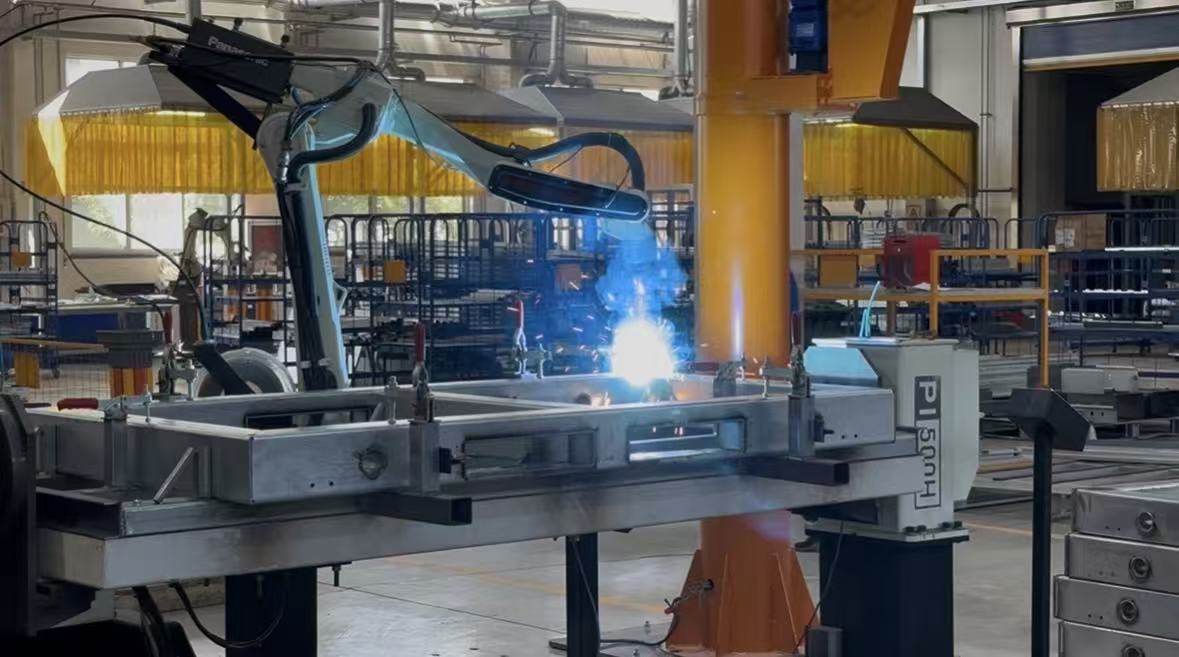
Industrial robot installations exceeded 500,000 units globally for the fourth consecutive year, with welding remaining one of the largest application categories. Modern robotic welding cells integrate real-time monitoring, adaptive parameter control, and digital traceability systems that record weld quality data for every joint produced.
This level of documentation is increasingly important for B2B buyers in regulated industries—aerospace, medical, energy—where weld integrity must be verifiable and traceable throughout the product lifecycle.
Welding Technologies Relevant to Sheet Metal Fabrication
Different applications demand different welding processes. A capable sheet metal fabrication partner should offer multiple welding capabilities to match the right process to each project’s requirements.
CO₂ Gas Shielded Welding (GMAW/MAG)
The workhorse of general sheet metal fabrication. CO₂ gas shielded welding is cost-effective, versatile, and suitable for mild steel and some stainless applications. It offers good deposition rates and is forgiving of minor fit-up variations.
Best suited for: General enclosures, brackets, frames, and structural components where cost efficiency is prioritized.
TIG (Argon Arc) Welding
Tungsten Inert Gas welding produces high-quality, clean welds with excellent appearance. It is slower than MIG but offers superior control for thin materials and critical joints.
Best suited for: Stainless steel fabrication, food-grade equipment, architectural metalwork, and applications requiring aesthetic weld beads.
Laser Welding
As discussed, laser welding delivers precision, speed, and minimal distortion. Recent advances have extended its capability to sheets up to approximately 6 mm (0.24 inches) in heat conduction mode, making it viable for a broader range of sheet metal thicknesses.
Best suited for: EV battery trays, electrical enclosures, furniture components, and precision assemblies where distortion control is paramount.
Hybrid Laser-Arc Welding
Hybrid processes combining laser and arc welding (such as laser-GMAW or the emerging laser-SAW) are pushing the boundaries of thick-plate fabrication, though for most sheet metal applications, standard laser or arc processes remain the primary choices.
How Welding Fits Into the Sheet Metal Fabrication Workflow
Understanding where welding sits in the production sequence helps buyers evaluate supplier capabilities and anticipate potential bottlenecks.
Design and engineering review: Weldability assessment, joint design, and material selection.
Cutting and forming: Laser cutting, punching, or plasma cutting, followed by bending and forming.
Fit-up and fixturing: Components are positioned and clamped in welding fixtures or jigs. Fit-up tolerance directly affects weld quality.
Welding operation: Manual, semi-automatic, or robotic welding based on volume, complexity, and quality requirements.
Post-weld processing: Grinding, polishing, heat treatment, or stress relief as needed.
Quality inspection: Visual inspection, dimensional verification, dye penetrant testing, or X-ray for critical applications.
A supplier’s ability to control fixturing and fit-up is often the difference between consistent quality and variable results. Modern approaches include jig-less welding using mortise-and-tenon joint designs combined with laser conduction welding, which reduces tooling costs for high-mix, low-volume production.
What B2B Buyers Should Evaluate When Sourcing Welded Sheet Metal Components
When selecting a sheet metal fabrication partner, welding capability should be assessed across several dimensions:
Process breadth: Does the supplier offer the welding process best suited to your material, thickness, and quality requirements? A supplier with only MIG welding may not be the right fit for precision stainless or thin-gauge aluminum.
Automation level: Robotic welding provides consistency for repeat orders; manual welding offers flexibility for complex or low-volume work. The ideal partner has both.
Quality systems: Certifications such as ISO 9001, IATF 16949 (automotive), AS9100 (aerospace), or EN 1090 (structural) indicate documented process control.
Traceability: Can the supplier provide weld records, material certifications, and inspection reports?
Engineering support: Design-for-welding feedback during the quoting stage can prevent costly rework and improve manufacturability.
Frequently Asked Questions from B2B Buyers
Q: What is the difference between a “weldment” and a standard sheet metal part?
A weldment is an assembly created by joining multiple sheet metal components through welding. While a standard sheet metal part is typically formed from a single piece, a weldment combines cut, formed, and welded elements to create complex structures that cannot be produced through bending alone. Common weldment examples include machine frames, chassis assemblies, and structural brackets.
Q: How does welding affect lead time and cost in sheet metal fabrication?
Welding is typically a labor-intensive operation, especially for manual processes. Robotic welding can reduce cycle times by 50% or more for repeatable parts, while laser welding offers speed advantages for thin materials. Cost drivers include joint complexity, required quality level, post-weld finishing needs, and whether fixtures are required. Early engagement with a supplier’s engineering team can often optimize joint design to reduce welding time without compromising strength.
Q: Can you weld dissimilar sheet metals?
Yes, but with important limitations. Laser welding has demonstrated success with dissimilar material combinations where conventional arc welding struggles. However, differences in thermal expansion, melting points, and metallurgical compatibility can create brittle intermetallic compounds. For critical applications, buyers should specify weldability testing before production commitment.
Q: What quality standards should I require for welded sheet metal components?
The appropriate standard depends on your industry and application. General industrial fabrication typically requires ISO 9001 with documented welding procedures. Automotive suppliers should hold IATF 16949. Aerospace and defense applications demand AS9100 and NADCAP accreditation for welding. Structural applications may require EN 1090 or AWS D1.1 compliance. Regardless of standard, buyers should request weld procedure specifications (WPS) and procedure qualification records (PQR) for the specific materials and thicknesses involved.
The Path Forward: What Advanced Welding Means for Your Supply Chain
Welding in sheet metal fabrication is undergoing a fundamental transformation. The convergence of laser technology, robotic automation, and digital quality systems is creating new benchmarks for precision, consistency, and traceability. For B2B buyers, this shift presents both opportunity and risk: opportunity in the form of higher-quality, more reliable fabricated components; risk in the form of supplier selection, as not all fabricators have invested equally in modern welding capabilities.
The most competitive suppliers are those that combine process breadth with automation depth—offering the right welding technology for each application, backed by documented quality systems and engineering support. As you evaluate potential partners for your next sheet metal fabrication project, prioritize suppliers who can demonstrate not just welding capability, but welding intelligence: the ability to select, control, and verify the optimal process for your specific requirements.